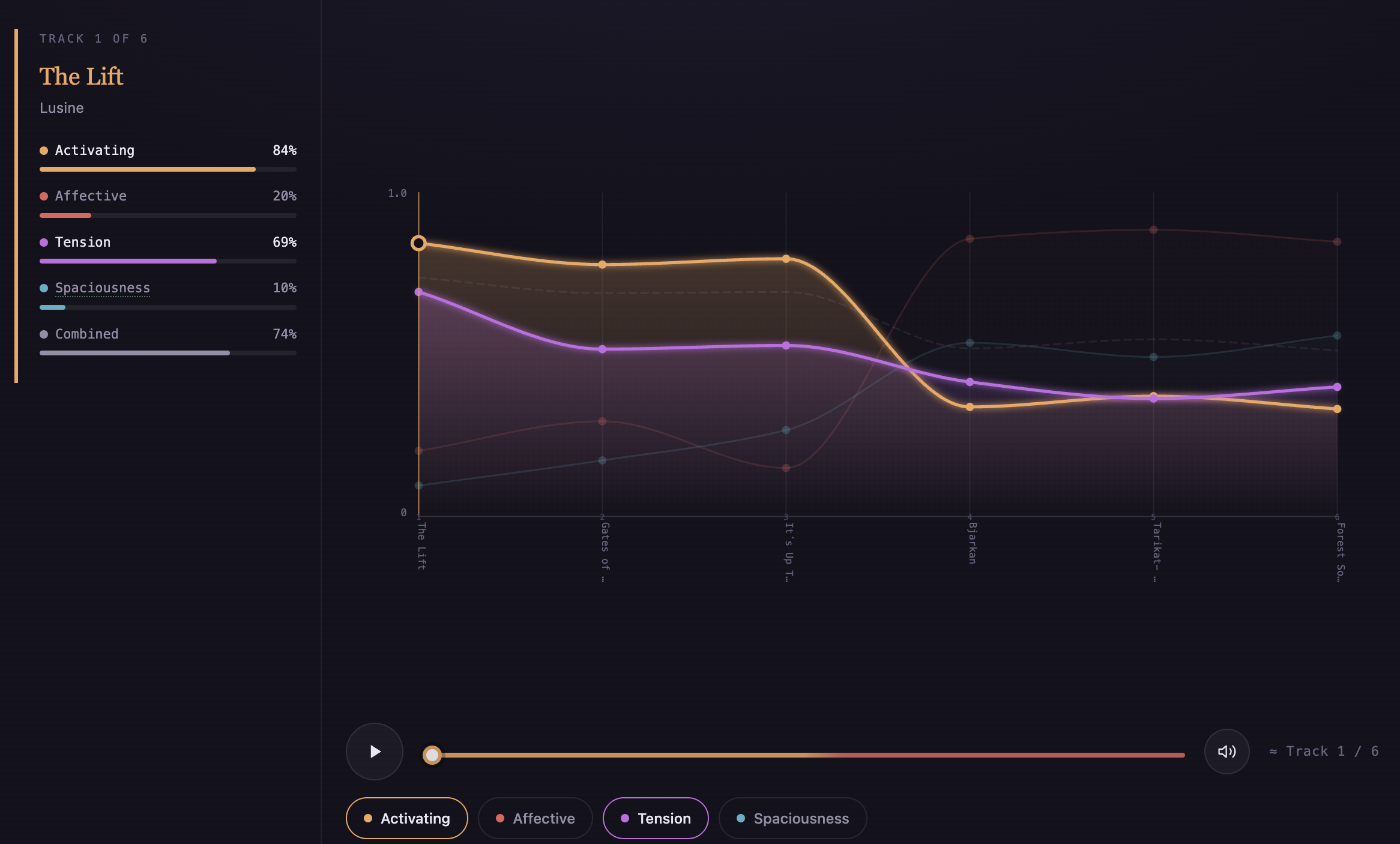
We need a new vocabulary for the types of music used in Holotropic Breathwork
Traditional musical vocabulary isn't especially helpful. Terms such as fast, slow, major, minor, ambient, or cinematic describe aspects of the music itself, but they tell us very little about the way that music functions within an expanded state of consciousness.
Likewise, genre is often irrelevant. A powerful piece for breathwork might be orchestral, electronic, devotional, indigenous, experimental, or entirely acoustic. What matters is not what the music is, but what it does.
As I worked through hundreds of hours of music for the course, I found myself looking for language that described the different kinds of intensity we rely on during a Holotropic Breathwork session. Intensity is central to the arc of a well-constructed set, yet not all intensity is the same.
Some music drives the process forward through rhythm, momentum, and energy. Other pieces evoke equally powerful experiences without relying on movement at all. Both can be deeply intense, but they activate the psyche in very different ways.
Describing music in the first two hours by using two types of intensity
To distinguish these qualities, I began using two terms: Activating and Affective. The distinction is not intended as a rigid classification, but rather as a way of recognising two complementary forms of intensity.
Activating music generates movement.
It creates energy through rhythm, pulse, repetition, dynamic development, and increasing momentum. It invites the breather into action. The body wants to move, breathe more deeply, engage with the unfolding experience. Percussion, driving strings, tribal rhythms, electronic textures, and insistent motifs often belong here, although activating music is certainly not limited to these styles. Its defining quality is that it mobilises.
Affective music, on the other hand, generates intensity through psycho-emotional and psycho-spiritual depth.
It reaches the heart more than the muscles. A single sustained cello line, an expressive vocal, a spacious harmonic progression, or a slowly unfolding orchestral passage can carry enormous emotional weight without ever becoming rhythmically energetic.
This music doesn't necessarily push the experience forward; instead it deepens it. It invites surrender rather than activation.
These two forms of intensity correspond closely with what many facilitators already observe during the first two hours of a Holotropic Breathwork session. The opening stages of the musical arc often rely more heavily on activating material, helping to gather energy and establish the momentum of the process. As the session progresses, that energy frequently begins to transform into something more emotionally nuanced.
The music becomes increasingly affective, allowing whatever has been mobilised to reveal its emotional and symbolic dimensions. Affective tension is more than just emotion, it can point to deep human states of awareness and being that are profoundly spiritual and profoundly human.
The breathwork playlist is on a spectrum of three distinct nodes.
Thinking about the music this way also helped clarify something that extends beyond individual tracks. The intensity of an entire Holotropic Breathwork set can be understood as moving across a broader spectrum with three interconnected nodal points:
Tension → Resolution → Release.
This is not simply a musical structure. It is also a psycho-spiritual / emotional one.
Every meaningful therapeutic process involves some encounter with tension. Whether that tension is physical, emotional, symbolic, interpersonal, or spiritual, it represents energy that is seeking expression. The music does not create this tension from nothing; rather, it provides conditions in which existing tensions can safely emerge and become available to experience.
The first form of tension is activating tension.
Activating tension is created through movement, anticipation, rhythmic insistence, and increasing energetic demand. The music gradually asks more of the participant. It encourages fuller breathing, greater engagement, and a willingness to move toward rather than away from experience. Importantly, activating tension is not about stress or anxiety. It is an invitation into vitality. It helps mobilise the energy that allows unconscious material to surface.
Fast drums, and didjeridoo help to build tension and activation in the first hour of a breathwork set. This track builds tension slowly with a somewhat relentless forward momentum supported by traditional song, clap sticks matched with a thumping bass beat.
The second form is affective tension.
Here, the tension is no longer primarily about movement but about feeling. Emotional ambiguity, longing, grief, beauty, tenderness, awe, mystery, and vulnerability all create their own kind of intensity. A piece can be almost motionless while carrying extraordinary affective tension because it opens emotional space that asks to be inhabited rather than resolved. In many sessions, this is where profound personal material begins to unfold—not because the music becomes louder or faster, but because it becomes emotionally more available.
The piece above is a relentless unresolving piercing cello track that although relatively minimal holds tension throughout the 9 minutes or so of the piece.
Activating and Affective tension often overlap eachother - and often in the transition into the second hour.
These two forms of tension are not separate phases so much as complementary forces. They overlap continuously throughout a session. Highly rhythmic music can be deeply emotional, and emotionally spacious music can contain powerful momentum. The distinction simply gives us language for recognising which quality is doing the primary work at a given moment.
Eventually, both forms of tension seek movement toward resolution.
Resolution: What happens when the tension starts to complete?
Resolution is not the same as conclusion. Rather, it is the point at which the accumulated psychological energy begins to reorganise itself. Experiences that have been fragmented may begin to connect. Emotional states that seemed overwhelming often become more coherent. Images, memories, bodily sensations, and insights start to find relationship with one another. The music supports this process by gradually introducing greater openness, stability, harmonic spaciousness, and emotional integration without collapsing the intensity prematurely.
Glorious Summer is perhaps a more traditional soundtrack piece which is clearly at the point where hope has well and truly entered the room. Whereas the two tracks before are holding tension through forward momentum and then through suspenseful holding this piece has a feeling of opening up to a possibility that is already here.
Musically the pieces that precede resolution often feel unfinished with the listener feeling left hanging. Tension builds and never fully resolves. Whereas at the point of resolution we might see music shift into a major key with a chord progression that comes to a point of completion which delivers to us the feeling of resolution.
Service by Peter Kater and co is a great example of a piece that is in full resolution mode. There is something that is reassuring and affirming about this piece. It feels to me like all the work has been done and now the angels have arrived to celebrate with us.
Release: What happens when the tension has completed?
Only after the resolution occurs does the final movement toward release become possible.
At the same time, it is important to recognise that an individual's process rarely unfolds in perfect synchrony with the musical arc. While the music follows a carefully considered trajectory from activation through affective depth toward integration, participants often move through their own unique rhythms. Someone may encounter their deepest emotional material during an early rhythmic piece, while another may still be working intensely during music that is intended to support resolution or release. In my experience, this is not the exception but the norm.
Receiving by Anna, Laraaji and Jon Hopkins is actually one of my favourite pieces to end a set on. It's not the full drift that we might see for the better half of the third hour but it contains such a feeling of homecoming and softness with no hint of tension whatsoever.
Music in a Holotropic Breathwork set is well and truly a container to hold the depth and breadth of the breathers experience.
The function of the music, then, is not to choreograph the psyche or determine the timing of a person's experience. Rather, it creates a holding environment—a broad energetic and emotional landscape within which many different processes can unfold simultaneously. The arc of the music provides direction without imposing it. It offers invitations rather than instructions, trusting that each participant's inner healing intelligence will engage with the music in the way that is most needed.
Seen in this way, the music throughout a Holotropic Breathwork session is never merely background. Every piece participates in a carefully shaped continuum of tension, resolution, and release. Within that continuum, both activating and affective intensity play essential roles. One mobilises experience; the other deepens it. Together they help create the conditions in which the psyche can move toward its own inherent capacity for healing, expression, and integration.
Developing this language has also changed the way I listen. Rather than asking whether a track is "good for breathwork," I now find myself asking a more useful question: What kind of tension does this music create? The answer often reveals not only where a piece belongs within a set, but also the unique contribution it can make to the unfolding journey.